
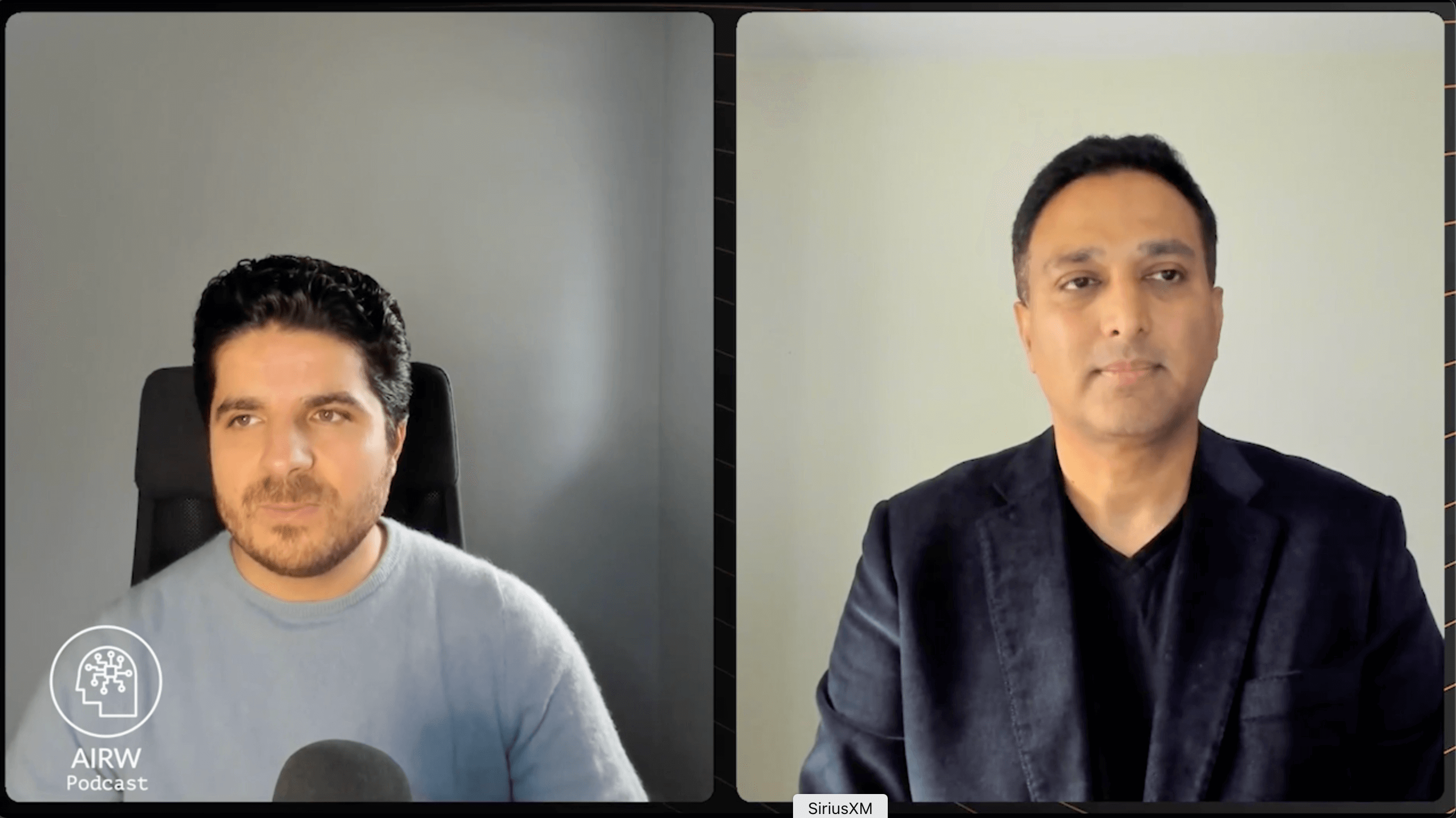

Hello, everyone. I'd like to welcome you to the first episode of our new podcast, A.I. in the real world. Today, we've got a really exciting conversation between Taleb Alashkar and Ramesh Raskar. I'm
So first, we're going to start with Taleb. Taleb, how are you today?
Doing great. Thank you, Jeffrey.
Excellent. Excellent. So Taleb, why don't you tell us a little bit about yourself, and then I can kind of dive in and poke around if we need to poke around a little bit more.
Yeah, thank you.Jeffrey. I'm the CTO and co-founder of AlgoFace. I have a Ph.D. in Computer Vision Machine Learning from France back between 2011 and 2015. And then I moved to the US in early 2016 to
After that, I was working for a company for driver monitoring systems here in Michigan, where I moved from Boston. And since 2017, working on AlgoFace, which was incubated inside another company, Algo
Like we focus on an inclusive, unbiased A.I. solutions for the human face.
Awesome. Thank you very much. That's going to make for a great conversation here today. Ramesh, I'm going to toss it over you. Same question. Give us a little intro about yourself. Tell us some accomp
Thank you, Jeffrey. Wonderful to be here. I'm Ramesh. I'm a professor at MIT and a lot of my work is at the intersection of computer vision, machine learning, imaging and digital health. I think we li
So my excitement is really at the intersection of the digital and physical systems.
Awesome. Awesome. So this is definitely going to be a great conversation. Ramesh, I see you have a bunch of awards in here. You know, I'm looking at your LinkedIn. I advise everybody who's listening t
Tons of great accomplishments, tons of great experiences that they've had. Ramesh, you've got a ton of awards here that I'm looking at, is there any one of these that really jump out that we want to t
I mean, the awards that I'm really proud of for the work done by my students, my post-docs on my colleagues. And you know, it's unfair that award has my name on it. But really, I know a recognition of
So awards like the Lemelson award that recognizes accomplishments in engineering or my ACM Siggraph award, which recognizes accomplishments in visual computing are, you know, just make me very proud g
Awesome. Awesome. Yeah, definitely shows. Obviously, you know, your guidance and your tutelage certainly moves these things along, which is going to be fantastic. So I want to kind of dive into our co
I want these two brilliant minds to kind of have a conversation about where our A.I. is, where they see it going, and some of the cool technologies that are going into A.I. today. So I'm going, I'm go
And certainly I'm here. If we need being.
Yeah, I can start. Thank you, Jeffrey and Taleb. Let's talk about, you know, the current state of AI and some unspoken challenges. And as we look at, you know, the tremendous progress in the ability t
But data continues to remain one of the bottlenecks. And one mechanism around that is to simply harness the data that's either outsourced or tap into sources that remain siloed. And to do that, there
One is, first of all, we have to figure out if the data is reasonable quality. And so some kind of data janitorial work is very critical. The second is that a lot of the data is actually very sensitiv
It could be health data or identifiable data, financial data, and it's important to gather that in a way that preserves privacy and overcomes bias and other important values. And the third is that the
So far, we're seeing the web to print world. The incentive has mainly been, you know, some other tentative benefits, whether it's social media or, you know, traffic directions and so on. But as time g
So I see that there's three main challenges in dealing with data. So Taleb, I know you're excited about, you know, many aspects of compute algorithms as well as data. What do you see as the current bo
Yeah. When it comes to data like that it's true, like A.I. becomes really in our lives. Recently, it's departed from research labs into our lives, like around ten years ago for two reasons like comput
Now, like maybe more than 90% of any A.I. solution in action is deep learning-based and provides supervised-based learning approach. But now, like when we figure out, like, there's a lot of data when
Or biometric data that we are dealing with in AlgoFace or the data themselves are not representative enough. But there's always different data. You you acquire data from different machines, from diffe
That's a very, very big challenge, time consuming and resource consuming ahead of any AI or machine learning based project. Now we believe thanks to the advancement in two areas, the one it's procedur
So that's fascinating, right Taleb? I mean, the ability to create new synthetic data, and it kind of reminds me of the trends in, you know, genetic cloning, you know, the Dolly the sheep. And the conc
And so right now, we, in the world of synthetic data, we always need some data before we can create more synthetic data. So let's go back to the beginning of synthetic data, right? I mean, there are c
First of all, it can be created in large quantities without worrying about, you know, tapping into real world data. Once you have some real world data, as far as a genesis center, data can be simulate
So kind of compute can generate data, which is always fascinating. It has benefits that when you do release the synthetic data, you don't have to worry about issues like privacy because if you do it r
And probably the most important is that in synthetic data, you can play with parameters that matter for training machine learning, like bias and sample size and so on. So we feel that, you know, the w
Yeah, that's very true, like it is maybe like a Catch 22, a problem in the world of data. I need some data large enough to generate synthetic data. If our ultimate goal is to kill the need of real dat
And you can really get this 1 million out of maybe a few thousand if you have the same pre-trained model or just as an A.I. transfer learning technique. The dilemma here is startling that the syntheti
We should like, not view that blindly. And there's some technique to overcome that technically by using some differential privacy techniques or federated learning, maybe, Ramesh Raskar, you can also comment
A still-emerging field, there's no final solution, but I still see very voluble and using the differential privacy and federated learning can reduce and mitigate these threats to a high level.
That's absolutely true. I think that's one of the challenges you mentioned with synthetic data, such as the need for some original data before it can run a generative model on it. And second, from a l
Because what you've trained on synthetic data may not generalize to the distribution of the real data that you actually care about, a real, and the benefit of synthetic data that you could reduce leak
Algorithmic data is very critical. I mean, I would say techniques like differential privacy or federated learning or what we do in our group at MIT, which is called split learning, which is a variatio
So techniques like split learning and others can definitely play a very critical role in maintaining privacy. But don't you think there are somewhat orthogonal to synthetic data? Because the whole ide
Don't you think the benefit of synthetic data is something you can just put it out there and you can either buy it or sell it or produce it yourself? And it's almost like a, you know, a JPEG file that
Yeah, that's true. Like those two things that help you to find the leakage of sensitive information from real data to sensitive data at the same time may reduce the quality or the value of sensitive d
Synthetic data also, it is not only about privacy. Yeah, privacy is very, very important topic now in the age of A.I., how we can have high, accurate A.I.-based solutions without sticking the privacy
For example, corner cases and edge cases in many scenarios. You cannot find, for example, think about some skin condition, using A.I. Or some skin…dermatology. There are some common diseases that you
And but there are some orphan diseases and very little like whatever you leave, you will never add, so you always have a huge dataset of imbalances classes. So without synthetic data generation or dat
Also, since big data as well, I believe it's played a very, very critical role in imbalance in data, especially when you want to tackle real world scenarios like skin condition and disease. What do yo
I think that's a very valid point that, you know, the bias in the data that we worry about can really, really play a critical role. And the example you gave of this highly heterogeneous datasets is a
It's an important one. So, I take that for sure. Maybe on that note, we can jump into some of the things you are already doing in AlgoFace, Taleb. Can you tell us, can you share a little bit about how
Yeah. In all the phase, we focus on developing A.I./A.R. solutions related to human face like face tracking technology, facial certain facial attributes or something related to hair as well, collectin
Collecting the data and adlibbing is extremely difficult, tough problem and time consuming to a human in the loop. Like when you want to put 100 people to, to label your data, it is difficult to contr
So we have like synthetic faces. that we can generate in an extremely realistic way. Also, we can control the attributes that we are generating in certain…to a certain degree. So not only are we gener
Also, in many cases, you can create 100% perfectly labeled data already. So that's a huge advantage, right? Think about if you can generate like people with different skin colors, you know, and if you
That's great, can you…I mean, if I think about the world of renderings, which, as you know, a lot of self-driving car industry uses for its training, versus synthetic data which, as we just discussed,
But using generative models as goes forward to kind of rendering of scenarios and faces and so on, which are the superior synthetic versus data generation. These two techniques today are somewhat dist
Yeah, I think I see it coming together already. I see people in the market already, like, trying to marry these two thing to have more efficient synthetic generation when it comes for simulation engin
When it comes to the human face, it is not easy. There is no easy way to generate the synthetic face model, a realistic one – you can maybe easily create cartoonish face, but if you want to have some
I think both of them can play nicely together, it's still in its infancy. It's just started, I believe. I think like in the next three to five years, we will see many platforms for generating…like tra
they will start to incorporate some generative models technique, embodying it and start to help them to generate and adding new features to those spaces. And that would cause certain, like, maybe conc
I think those like you will, we will start to maybe look at faces that we don't see in the real world. We don't know how those algorithms explicitly working, and maybe that will affect our perception
Like recently, I bought a book, an artistic book, about face coloring for kids. And what is nice about that book, all those pictures of faces that have been created by generative model by A.I. So ther
Fascinating, fascinating point about how society might perceive these faces. I mean Hollywood actors have been worried about virtual actors replacing them for a very long time. It hasn't happened yet,
Yeah, I think digital influencer now and digital avatars now it's becoming a really, very big thing, especially in South Asia now, there's a huge industry about digital influencer or digital avatar, t
…they have multimillion followers on their YouTube channels, some of them targeted to our kids as well. I think this is something really for me, like. From a scientific perspective, it is extremely ex
Certainly. I mean, when it comes to generative synthetic data, is there something special about human faces compared to other data? Because, you know, kind of evolutionary, we are so attuned to even t
So is there, is there something specific about human faces that you encounter in your work at AlgoFace compared to other synthetic data generation?
Absolutely. The human face is the most captured object in history from, you know, from even like painting or photography, like, millions of faces like, you know, people like, everything about the huma
So people, like, genuinely care a lot about face, and when you start to create synthetic faces…the bar is really high. Yeah, for example, if you are generating synthetic, I don't know, like, products
Yeah, absolutely. I think this uncanny value problem has not been easy for even special effects to overcome. So it's…it involves a lot of creative, talented input and the likelihood that a pure algori
So given that I mean, as you know, there are about a dozen companies that sell so-called generative synthetic data products out there. But I assume AlgoFace creating generative representative faces is
Yeah. You know, I feel like there's very, very few players in this market, like very few and maybe around the globe to the best of my knowledge, there's less than five. Something around five serious c
All of them emerging in the last couple of years. So there's very, very few players, there's some few companies that we are talking with about their ability of generating synthetic, realistic faces. A
So we are working also internally because we have already built a new data set, a proprietary data set, that we know our problems very well, we have a very good pool of talent in that area. So mostly,
Yes, that's, that's fascinating. I mean, I still remember the demo video that you and the AlgoFace team had posted about two years ago on being able to do facial landmark detection in real time, indep
And then just to kind of wrap up, what are your…how do you see it? I mean, one dream you say is, you know, so little data, you know, you said if the order of 100 images is enough to create, you know,
Can you share with us how you see this field progressing over the next few years, especially with respect to how you see this inside AlgoFace?
Yeah. In general, I think one of the fundamental problems now in A.I. that needs to be solved is the ability to transfer knowledge from one problem or one space to another, like as our brain, for exam
So, but I think our brain works in a different way when we build object recognition ability in general, regardless of the object themselves. Then we can start to add some library to those objects, and
That, if we arrive at this stage of maturity also provides learning or unsupervised learning that can solve and reduce and remove a huge meaning of new data ad-libbed data. But all these problems that
I think the next breakthrough that can happen, is…how about developing some A.I. models that are not really very, very, very hungry for a lot of data? That's really the 1 billion dollar question. If s
Now telehealth is huge, booming after COVID, digital psychiatry, digital health, digital vital sign retention. I think if we can build real time solutions that are built inside the consumer device, wh
That's, that's fantastic, I mean, you're absolutely right that, you know, generated synthetic data and its transfer learning and generalization is just the beginning, but it's a really exciting space.
I hope in the coming weeks we get to talk more about, you know, other aspects of A.I., especially as it relates to face A.I. Thanks a lot.
Thank you very much, Ramesh.
Gentlemen, I want to thank both of you guys for a fantastic conversation. I want to thank everybody for tuning in to this week's episode. Again, this is A.I. in the Real World. We had Taleb and Ramesh
Again, our podcast is going to be the ongoing discussions about this emerging and advanced technology from all the experts like Taleb and Ramesh. We're going to be covering topics such as the sciences
If you have questions, if you have topics you want to hear about, please feel free to reach out to me. Again, my name is Jeffrey Freedman, I can be reached at Jeffrey@algoface.ai.
We're looking forward to seeing you on future podcasts and thanks again to both of you. Really appreciate the time today, and I hope everybody got a lot out of it.
Thank you very much, Jeffrey.
Thank you.